Spiez Laboratory consolidates cooperation with the International Atomic Energy Agency (IAEA)
 IAEA
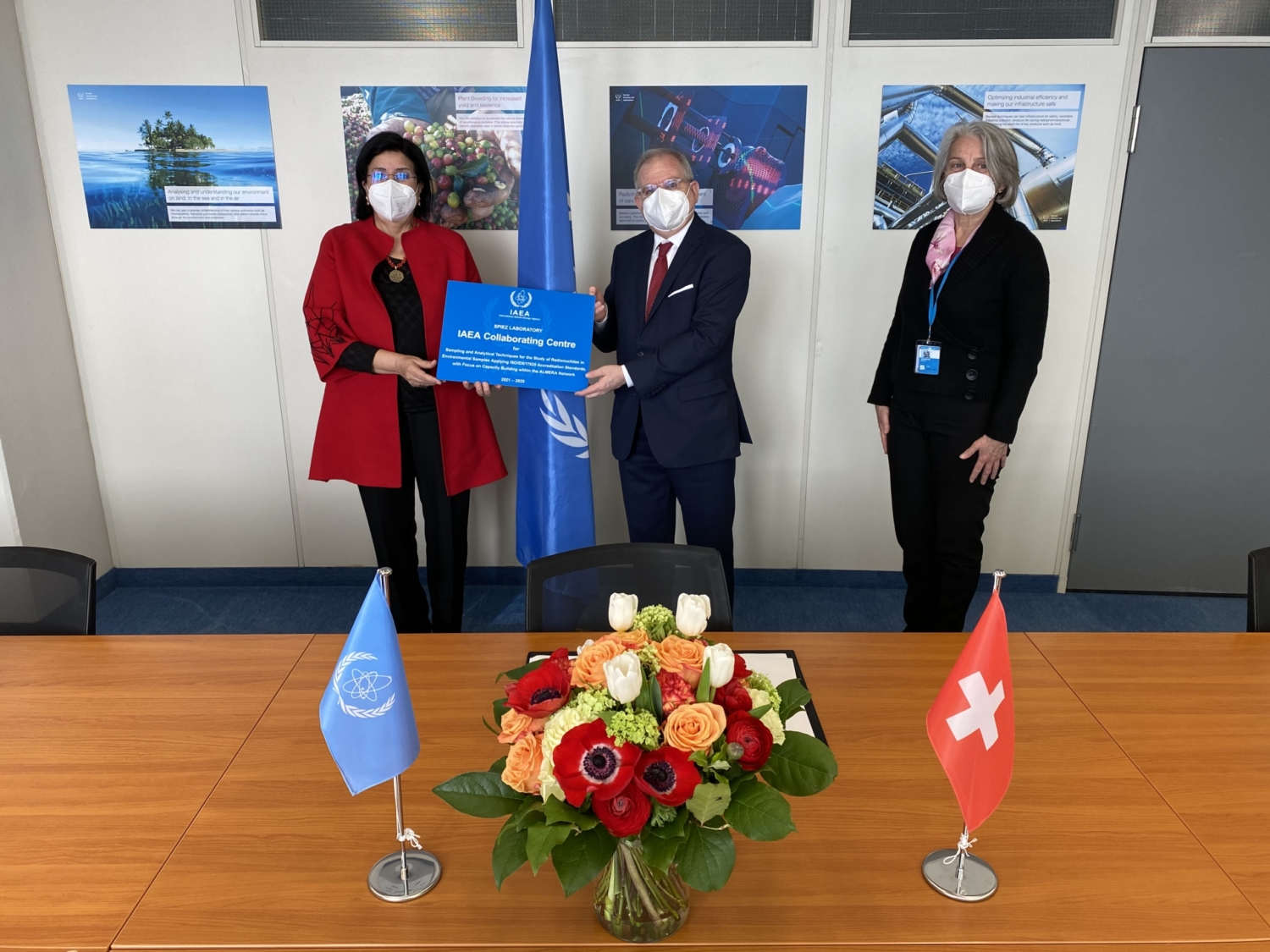
IAEASpiez Laboratory has been re-designated as a Collaborating Center of the International Atomic Energy Agency (IAEA) as of January 2021. The continuation of the collaboration is an expression of a very successful cooperation during the first designation period from 2017 to 2020. The collaboration with Spiez Laboratory includes in particular on-site measurements, sampling and the establishment of analytical procedures for the investigation of radionuclides in environmental samples. Another focus is capacity building within the IAEA's ALMERA network (ALMERA = Analytical Laboratories for the Measurement of Environmental Radioactivity). The continuation of the work concentrates on the development of analytical procedures for the investigation of radioactive substances in environmental as well as material samples. Concrete examples include support for the collection and monitoring of samples from coastal waters in the Fukushima prefecture (Japan) and the thematisation of the dismantling of nuclear power plants. In this area, metrological gaps for the classification of dismantling material are to be closed in the coming years.
The re-designation took place today during a short ceremony via video conference. In her address, Najat Mokhtar, Deputy Director of the IAEA Department of Nuclear Science and Applications, acknowledged the good cooperation with Spiez Laboratory and Switzerland. She said: "Over the past years, Spiez Laboratory has provided valuable expertise in establishing radioanalytical methods to achieve the highest quality standards in the Member States. Spiez Laboratory has played a crucial role in supporting Japan's marine radioactivity monitoring programme. Its nuclear chemistry department collected samples from coastal waters around the decommissioned Fukushima Daiichi nuclear power plant during last year's deployment. Experts from the Spiez laboratory also support the development of national radioactivity monitoring capacities in similar missions in the South Pacific. In particular, in the Republic of Marshall Islands, it is important to monitor the levels of fallout radionuclides from atmospheric nuclear weapons testing."
Collaborating Centers are select scientific institutions such as laboratories, universities and research institutes that work with the IAEA, particularly in the areas of environmental protection, food safety, resource management or public health. The IAEA currently maintains Collaborating Centers with some 47 institutes worldwide. Switzerland has a further IAEA Collaborating Center designated together with EPFL in Lausanne in the field of nuclear safety research. This is proof that nuclear research in Switzerland has a great international reputation and makes a significant contribution to the high national and international nuclear safety standards. The collaboration will enhance the scientific and technical capabilities in other IAEA member states and is in line with the Energy Strategy 2050, which envisages the continuation of nuclear research in the field of nuclear power plant safety. The SFOE, together with the FDFA, provided substantial support for the re-designation of the Spiez laboratory.
Ralf Straub, International Nuclear Energy Specialist, SFOE
 1 Vote(s), Durchschnitt: 5,00
 Loading...



Dein Kommentar
An Diskussion beteiligen?Hinterlassen Sie uns Ihren Kommentar!