Parliament passes CO2 law
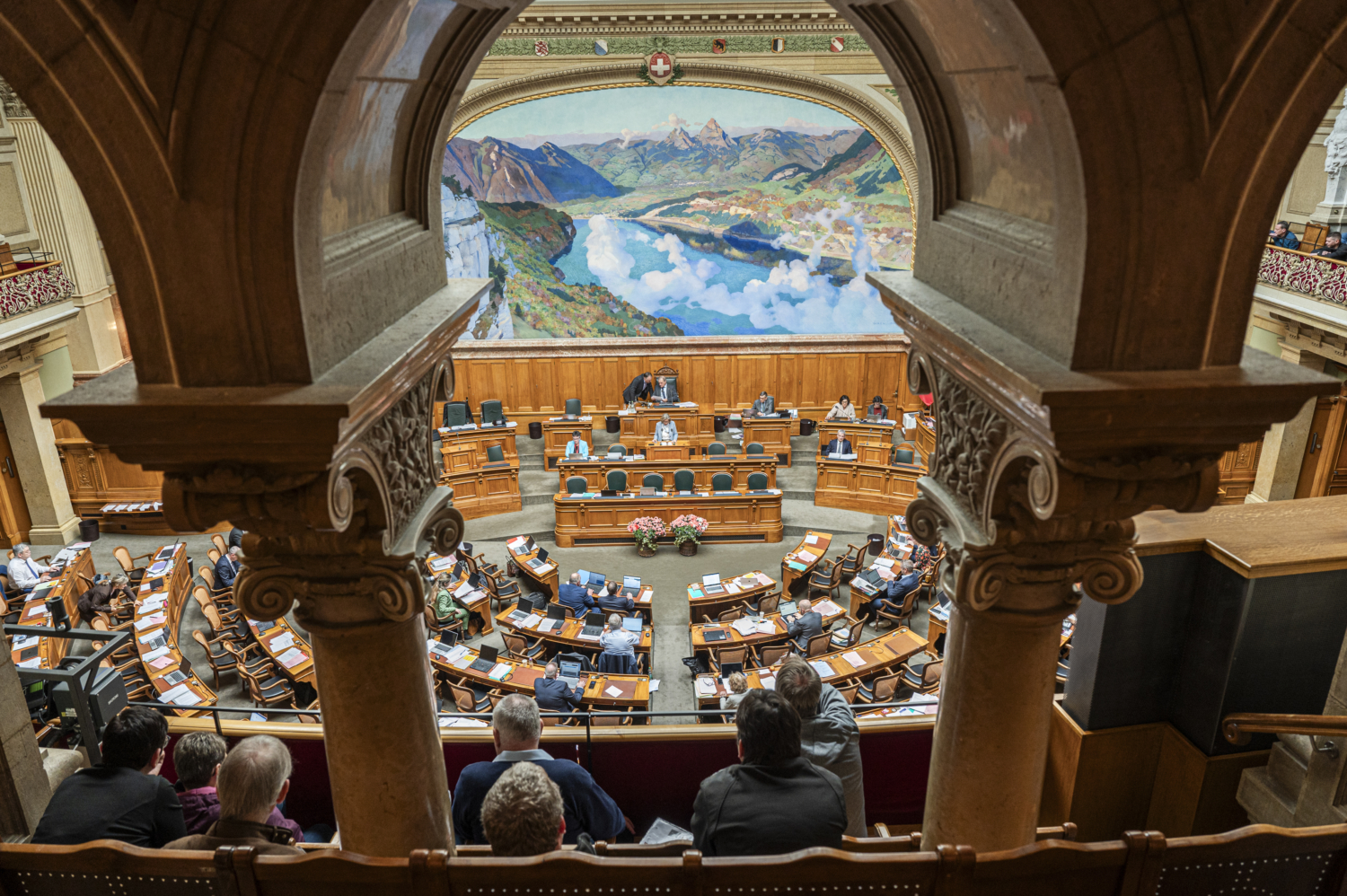 © Parlamentsdienste - Pascal Mora
It is now clear what the CO2 Act will regulate for the period from 2025. Parliament resolved the final differences in the spring session. Charging stations for electric cars will not be subsidized and CO2 emissions are to be reduced "primarily" in Switzerland.
The CO2 Act aims to halve greenhouse gas emissions in Switzerland by 2030 compared to 1990 levels. The revised law relies on incentives and subsidies instead of new levies, as envisaged in the version that was rejected by voters in June 2021.
There were still differences on the following points before the spring session:
- Promotion of charging stations
- Reduction target for CO2 emissions
And that was decided:
Basic installations for charging infrastructure in multi-party buildings and for companies with several workplaces in public parking lots will not receive federal funding. The National Council has accommodated the Council of States several times in the course of the debate by reducing the funding from CHF 30 million to CHF 20 million and waiving funding for public parking lots. The Council of States has always rejected funding with reference to the increasing electrification and the existing funding in some cantons. In yesterday's agreement conference, the Council of States' position finally prevailed by 14 votes to 12.
Furthermore, Parliament does not want a fixed quota for the reduction of CO2 emissions in Switzerland. The revised CO2 Act now states that the reduction in emissions should primarily be achieved domestically. The Council of States was also able to assert itself on this point. The National Council had demanded that 75 percent of CO2 emissions be reduced domestically, but then lowered the quota to 70 percent during the course of the debate.
Parliament has still not defined how quickly CO2 emissions from cars must be reduced in the period from 2025 to 2030. The transfer of passenger cars is also still possible. Every importer of passenger cars, regardless of whether it is a large or small importer, has the option of assigning a vehicle it has imported to another large importer for the purposes of calculating CO2 sanctions. Importers whose CO2 emissions balance is above the target values can, for example, include electric cars from another importer in their fleet and thus ensure that they have to pay less or no penalties.
Here is a selection of proposals that the National Council and Council of States have dealt with:
National Council:
The National Council is in favor of changing the system for the CO2 incentive tax on fuels: The Federal Council must examine whether this levy, which is currently reimbursed via health insurance premiums, could not be distributed directly back to households. The National Council has accepted a corresponding proposal from the Committee for the Environment, Spatial Planning and Energy (Urek-N).
Council of States:
Renewable gas was the subject of several motions:
The Council of States wants biogas plants to be able to sell their gas as biomethane. The Council of States followed the lead of the National Council and approved the proposal by Priska Wismer-Felder (Die Mitte/LU). The Federal Council must now submit the necessary legal basis for this to Parliament.
The Council of States is in favor of increasing the proportion of renewable gas. The potential in Switzerland and abroad should be taken into account. After the National Council, the Council of States also approved the UREK-N motion. The Federal Council must now create the legal framework.
The Federal Council is also instructed to develop an incentive system to promote the construction and operation of plants for converting solar power into synthetic gases (including hydrogen) and thus enable the storage of solar power. The Council of States has adopted the corresponding proposal.
Like the National Council, the Council of States is also in favor of exempting imported biogas from the CO2 tax. The Federal Council must now implement the proposal by Niklaus-Samuel Gugger (EVP/ZH).
The Council of States says yes to the proposal by Bruno Storni (SP/TI). He wants it to be easier to convert used cars into electric vehicles. The Federal Council must now amend the law and ordinance accordingly.
The Council of States also said yes to the motion by Thierry Burkart (FDP/AG) on the continued operation of existing nuclear power plants. The Federal Council must now produce a report setting out, among other things, the regulatory and financial framework conditions that need to be created to enable the existing nuclear power plants to remain in long-term operation and at the same time guarantee the safety of these plants.
Brigitte Mader, Communications, Swiss Federal Office of Energy
 Noch keine Bewertungen
 Loading...



Neuste Kommentare