When the Urseren valley was almost flooded
 CKW
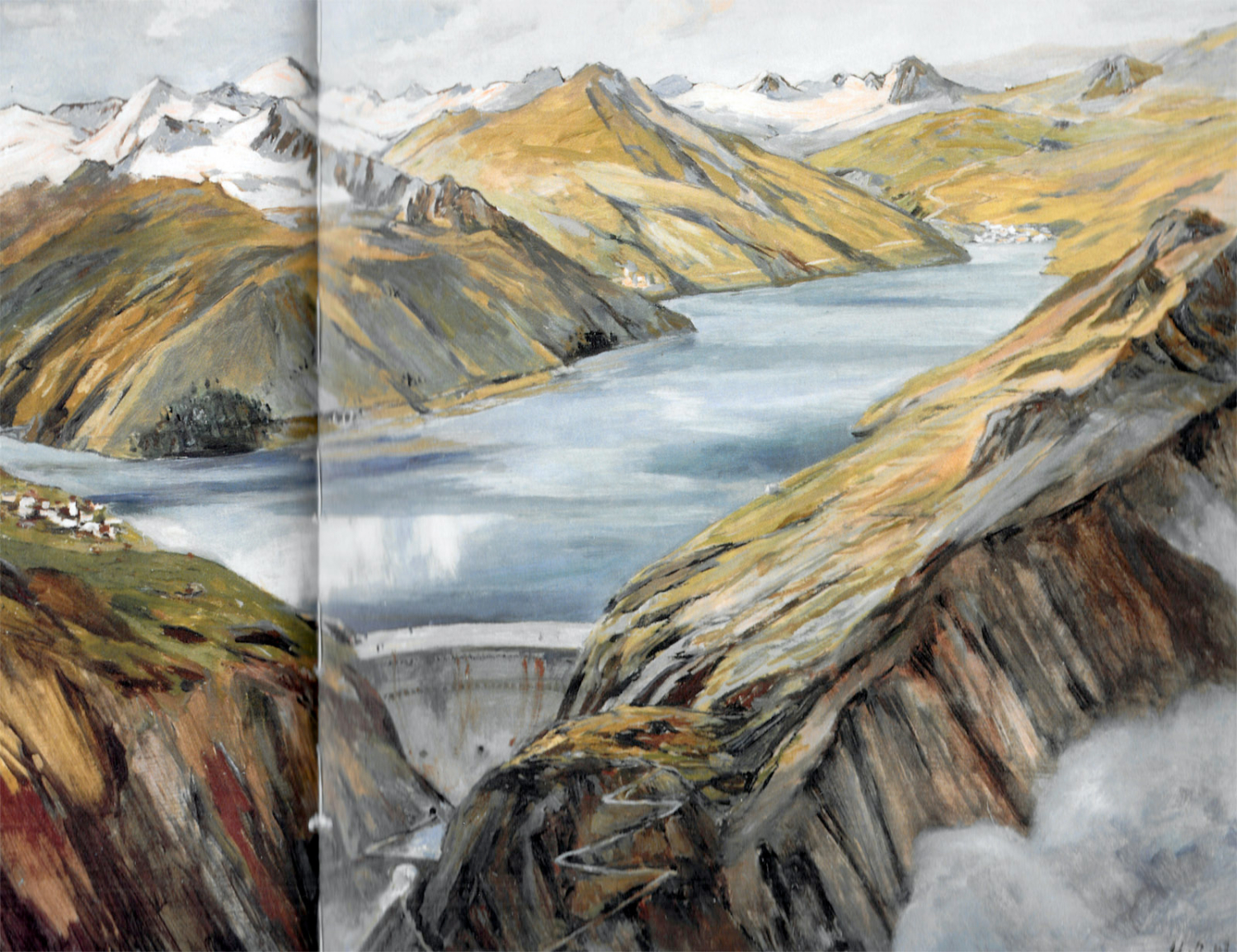
CKWThe Centralschweizerische Kraftwerke (CKW) wanted to build a hydroelectric power station in the canton of Uri, the largest in the Alps. It was a gigantic project: the entire Urseren Valley was to be flooded for it. It did not come to that. The locals literally fought tooth and nail against it. 75 years ago now.
Fritz Ringwald was a staunch advocate of hydropower. The director of Centralschweizerische Kraftwerke (CKW) predicted a great future for electricity. Even during the First World War, the country had to contend with dwindling coal supplies; in future, electricity from domestic production was to supply Switzerland even in times of crisis.
His company wanted to be part of this with a major project. Together with the Swiss Federal Railways (SBB), a bank and what would later become Elektrowatt, CKW planned the Urseren hydropower project, the large-scale Andermatt accumulation plant. In 1942 he told the newspaper Der Bund: "In the Urseren valley, in the middle of Switzerland, you could build a huge water barrel that would provide valuable power in winter
CKW had already presented its first project during the First World War. A 90-metre-high dam for a reservoir with 280 million cubic litres of water. In 1920, however, the three communities of Andermatt, Hospental and Realp objected. Their villages were to be relocated.
The NZZ of June 1, 1920, shows just how strong the opposition to this first project was. The federal authorities were also held responsible:
"It is right for the Heimatschutz to defend itself, but it will be even more useful if the federal authorities take steps to successfully counteract the inappropriate squandering and destruction of agricultural land. In a country where millions are spent annually in the melioration of lands and the creation of new lands, one cannot sit quietly by while valuable cultivated land is given away on the other side without any necessity for it."
And further:
"Now one may ask whether the loss of cultivated land here is not entirely, or several times, outweighed by the values created for the country by such a large power station. But the exploitation of water power at the expense of cultivable land is incompatible with the general interests of the country. And fortunately, in electric power transmission, one has not only a convenient means of directing power wherever one wishes, but also of deriving it from wherever one wishes."
The CKW finally stopped the project. With the construction of the Lungerersee power station begun in 1921, CKW's financial resources were tied up, so they no longer pressed for a decision on a building permit.
In 1935, the idea of an Urseren reservoir came up again - this time from the federal government: As part of a study of the available water forces in Switzerland, the Federal Office for Water Management proposed a new project. This was the first project to propose the damming of all the villages in the Urseren valley and also to provide supply pipes to bring water from the neighbouring valleys into the lake. However, the project, which was drawn up by the state, did not have any entrepreneurial objectives, so that it was not actively pursued.
During World War II, electrical energy consumption increased by leaps and bounds. Bottlenecks in supply occurred mainly during the winter months, when the production of run-of-river power plants decreased due to low water levels in the rivers. <a href="https://www.e-periodica.ch/cntmng?pid=woh-002%3A1945%3A20%3A%3A556">At the same time, the demand for energy for heating increased.
Therefore, there was an urgent need to find ways of building storage power plants that would make it possible to store the water produced by melting snow in the reservoir in the summer and use it to generate electricity only in the winter.
In November 1940, the CKW then submitted a new project for a hydroelectric power station in the Urseren Valley. A bar at the upper entrance to the Schöllenen Gorge was to close off the valley. The plan was to build a 200-metre-high wall to dam the Reuss. The dimensions of the project were to set new standards. A 10 km long reservoir with a capacity of 1200 million cubic metres of water. There had never been such a large power station in Switzerland before. Cost: 1128.4 million Swiss francs (price basis 1939), which corresponded to around 8.6 billion in 2010.
At 2.8 million kWh, the Urseren power station would produce twice as much electricity as the largest hydroelectric power station in existence today, the Grande Dixence in the Valais, and would have covered half the country's needs at the time. Andermatt, Realp and Hospental were to disappear into the water for it, and the Gotthard Pass road was to be relocated.
In 1942, engineer Ringwald told the newspaper "Der Bund": "We don't want to build such a huge plant out of big-mindedness, but because this power is demanded by the economy." And he enthused: "The Reuss would be left with a minimal quantum of water in the riverbed during the day in order to preserve the wildly romantic character of the Schöllenen Gorge, which is full of waterfalls. But even through the pressure tunnels, nothing would flow out in summer. All the water would be saved for the winter."
As great as the enthusiasm of the CKW was, it was not as great among the locals. At that time, there were just over 250 houses in the Urseren Valley. A good 2,000 inhabitants lived there, mountain people and farmers who made their living on the valley floor and had hardly ever left the valley, plus around 1,300 head of cattle and almost 2,000 goats and sheep. A resettlement? Unthinkable for most of them. Giving up their land to be submerged in the floods of a reservoir, unimaginable.
At a protest meeting in Andermatt in August 1941, the following remark was made, as the newspaper "Gewerkschaft" wrote in February 1983:
"Should the Urseren valley with its three villages, its down-to-earth, well-behaved population, its magnificent mountain scenery, its glorious history and age-old tradition fall victim to today's speculative, special and competitive interests, to the kilowatt-trading spirit?"
But it was not only the project in and of itself that met with opposition. The actions of the power plant promoters also caused displeasure in the valley. They sent agents to the Urseren valley to persuade the farmers to hand over their land. The Neue Zürcher Nachrichten of 3 August 1945 had the following to say:
"They think they can have a little joke and fun with the farmers, invite them to a free drink and Chlöpfer, and then they would certainly agree. But: The farmer from Uri is cunning and cagey and does not easily get involved with every stranger. Here, perhaps, the clever agents might for once fall a prey to the still cleverer mountain farmer."
And further:
"Moreover, he (the peasant) is not a cosmopolitan like the capitalist, who has his home precisely where his money rolls, to whom the outside world no longer means anything, but only Mammon. It isnot money that makes the peasant happy, but work and the cultivation of his soil, with which he remains rooted, as the Bergarve with the soil."
The mood among the locals was anything but benevolent. On February 19, 1946, the situation finally escalated. What happened then was to go down in history as the "Andermatt riot".
On that day, Karl J. Fetz had come to the Urseren valley. He was CKW's "representative for land matters", and his job was to ensure that the electricity company came into possession of the land. Some had already sold, including two hotels. But Fetz was to experience first-hand how resolutely most of them held on to their land.
250 people, women and men, stormed the hotel where Fetz was staying. They dragged him out of the hotel by force and drove him down the railway line to Göschenen. Afterwards, they devastated an architect's office where the plans and models for the reservoir were created, recapitulated the NZZ Folio in its September 2020 article "Wie das Urserental beinahe untergingging" ("How the Urseren valley almost went under").
Karl J. Fetz's son, Linus Fetz - who was still in kindergarten at the time - recalls in a report in the Aargauer Zeitung of July 2012 how his father came home at the time: "Father could hardly sit down. To this day I can see the impressions of the Trigguni nails on his back. He was trampled on with nail shoes." Bruises and lacerations, fractured ribs, transverse fissure of the sacrum, concussion. For 95 days he had been unable to work.
The rioters were given lenient sentences. And Fetz received a fine for false accusations, because he had called Ludwig Danioth, then a member of the government of Uri and a member of the Council of States, an intellectual instigator. The verdict of the court was "a real meanness" wrote the newspaper "Tat" in May 1948. The Federal Court then corrected these verdicts.
The initiators, led by CKW, finally submitted an application for a concession, which was rejected by the government of Uri. On 30 June 1951, the Urseren dam project was finally buried. In the meantime, an easier to realise alternative was in sight. A power station on the Göscheneralp.
"Theconditions there were ideal for a reservoir: the heavily glaciated area promised water even in rain-free periods," reads the CKW homepage.
CKW founded a joint venture with the SBB and took over the management. The largest power plant in Switzerland at the time was built. For cost reasons, a 155-metre high and 700-metre wide stone dam was built instead of a concrete wall.
In 1952, the licence application for the reservoir, which was to flood a sparsely populated area, was submitted. In 1954, the cantonal council of Uri approves the project. In 1962, the new power station goes into operation. Last year it produced around 440 million kWh of electricity, making it still one of the largest hydroelectric power plants in Switzerland.
Brigitte Mader, Communication, Swiss Federal Office of Energy
Hydropower in the Urseren Valley:
No reservoir, but various run-of-river power plants: hydroelectric power in the Urseren Valley is certainly used.
The Hospental hydroelectric power station went into operation in 1902. The plant uses the hydroelectric power of the Gotthardreuss river and produces an annual average of around 7.5 million kWh of electrical energy.
The Realp hydroelectric power station has been supplying energy since 1913. In 2007, after 800,000 operating hours, the plant was completely rebuilt. This made it possible to increase annual production from 2.4 to around 4 million kWh.
The Oberalp power station went into operation in 1962. It is the only plant of the Urseren power station that has a storage facility. With the Oberalpsee and the dam in the "Schön", energy production can be regulated.
The Realp II power plant has been in operation since the end of 2017 and produces around 10 GWh per year. This means that the equivalent of around 2500 households can be supplied with renewable energy from hydropower.

 4 Vote(s), Durchschnitt: 4,75
 Loading...




Zurück in die Zukunft. Heute fehlen uns in den Winternächten bis 3 GW – sofort verfügbar. Wir sind Import abhängig, meistens Kohlestrom aus Deutschland. Damit ist aber Schluss am Ende dieses Jahres.
Woher dann, in 8 Monaten, diese gewaltige Menge kommen soll, hat mir bis jetzt noch niemand klar und deutlich erklären können. Das sind immerhin etwa 1,5 x Grande Dixence oder 6 KKW Mühleberg (R.I.P.). Deutschland ist jetzt schon am Anschlag https://tinyurl.com/55hbt94s https://tinyurl.com/4untsbe7 Frankreichs alternder KK Park braucht viel Unterhalt, hat wenig Reserven, sicher keine Sympathie für die Schweiz, wenn überall notabgeschaltet werden muss, damit das Netz nicht zusammenbricht.
Wir sind nicht vorbereitet. Covid Mangel an Schutzausrüstung, Impfstoff ist eine Lappalie dagegen. Der Bund selber sagt es „Strommangellage : Das grösste Risiko“ https://tinyurl.com/yyrw3u2r
Und was macht die Politik, das UVEK, die Kommissionen? Warten auf den Elektro Godot?