Purchase remuneration and minimum tariffs for photovoltaic systems: What has the Federal Council decided for 2026?
 shutterstock
Anyone who feeds electricity from their photovoltaic system into the grid usually sells this solar power to their distribution grid operator. There are around 600 distribution grid operators in Switzerland, some of which have very different conditions for feeding solar power into the grid. This will change from January 1, 2026. New legal regulations will then come into force, which the Federal Council approved in detail on February 19, 2025. Energeiaplus explains what it's all about.
The new legal framework
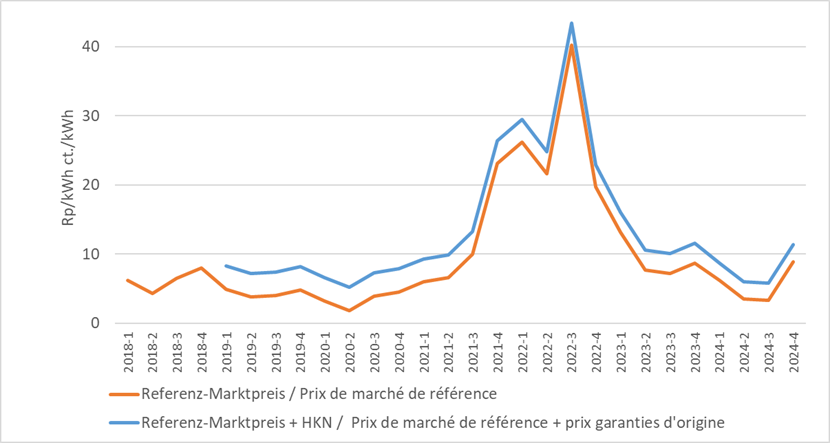
In principle, producers and grid operators must agree on the level of remuneration (sales price). If no agreement is reached, the sales price must now correspond to the quarterly average market price. The quarterly average market price is published regularly by the SFOE(feed-in remuneration). The reference market prices have averaged just under 10 Rp/kWh over the last seven years. Where grid operators have voluntarily accepted the guarantees of origin (GOs), the average price was as high as 13 Rp/kWh. The figure below shows the price trend from 2018 to today.
Investment security thanks to minimum tariffs
Minimum tariffs will also be introduced for smaller systems with an output of less than 150 kW from 2026. These will apply if the quarterly market prices are very low. The law stipulates that the minimum remuneration must be set at a level that allows typical installations to be amortized over their lifetime, even if the market price is lower over the entire 25-year period. This creates investment security for operators of smaller plants even in times of low market prices.
The Federal Council has decided on the following minimum remuneration:
- For all installations with a capacity of less than 30 kW: 6 Rp/kWh
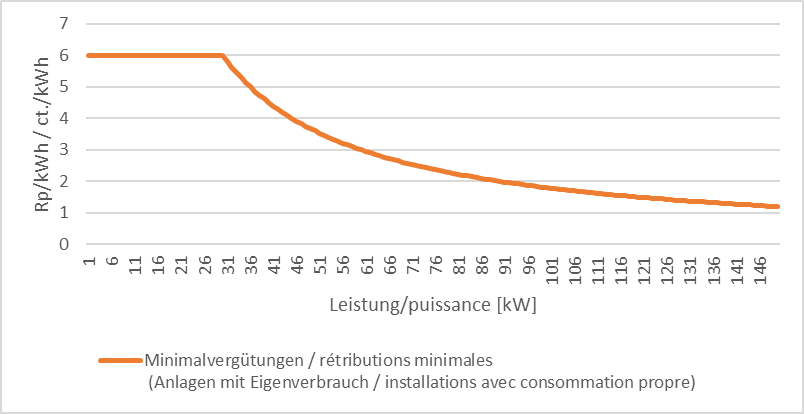
- For installations with self-consumption between 30 and < 150 kW capacity: between 5.8 and 1.2 Rp/kWh, depending on capacity,
The exact amount is calculated by dividing 180 by the capacity of the system. For example, the minimum remuneration for 60 kW is 3 Rp/kWh. - For systems without self-consumption between 30 and < 150 kW output: 6.2 Rp/kWh
The amount of the minimum remuneration for systems with self-consumption can be seen in the following chart.
How do the minimum tariffs work?
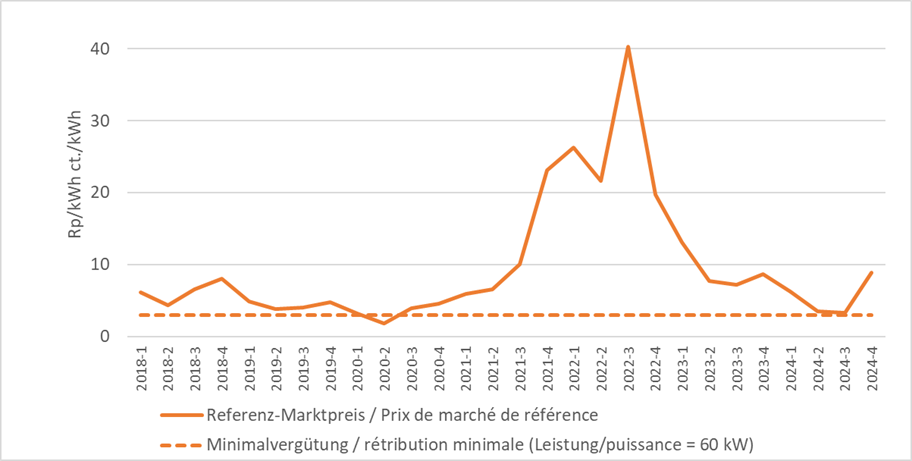
The figure below illustrates how the minimum remuneration works using the example of a system with an output of less than 90 kW and a minimum remuneration of 3 Rp/kWh.
If the operator feeds its solar power into the grid, the distribution grid operator pays the reference market price. If this falls below the minimum remuneration, shown here as a dotted line, then the minimum remuneration is paid. This means that the operator normally receives more than the minimum remuneration, which is only applied in exceptional cases.
Higher purchase prices thanks to HKN and new incentive models
In addition to grey electricity, the grid operator can voluntarily purchase guarantees of origin (HKN), which every operator of a photovoltaic system receives and can sell. These HKNs reflect the ecological added value of solar power compared to grey electricity.
The vast majority of grid operators already buy the guarantees of origin today. In 2024, the price for small photovoltaic systems was 2.4 Rp/kWh. However, grid operators can also pay more than the market price (or the minimum remuneration) for grey electricity and pass these costs on to their tied customers. In the Electricity Supply Ordinance, the Federal Council has specified the upper price limit up to which this charging on is permitted. For systems with an output of up to 100 kW with own consumption, this upper limit is 10.96 Rp/kWh, for example.
The grid operator is also free to agree special purchase conditions with producers. In order to relieve the grid of feed-in peaks and thus prevent expensive grid expansion, the level of the purchase tariff can be linked to special incentives, for example. One example of this is the "Top-40" product from the grid operator "Genossenschaft Elektra" in Jegenstorf. Here, producers receive an 8% higher purchase payment if only a maximum of 60% of the output is fed into the grid.
Wieland Hintz, Head of Solar Energy at the SFOE
 1 Vote(s), Durchschnitt: 5,00
 Loading...



Trackbacks & Pingbacks
[…] auf 6 Rp./kWh erhöht. Für Leistungen ab 30 kW mit Eigenverbrauch beträgt die Mindestvergütung für die ersten 30 kW 6 Rp/kWh, für die Leistungen darüber 0 Rp./kWh. Anlagen zwischen 30 und 150 kW ohne Eigenverbrauch erhalten 6.2 Rp./kWh als Minimum. Das BFE hat […]
Kommentare sind deaktiviert.