Dealing with radioactive waste in Switzerland - Part 3: Amount and types of waste
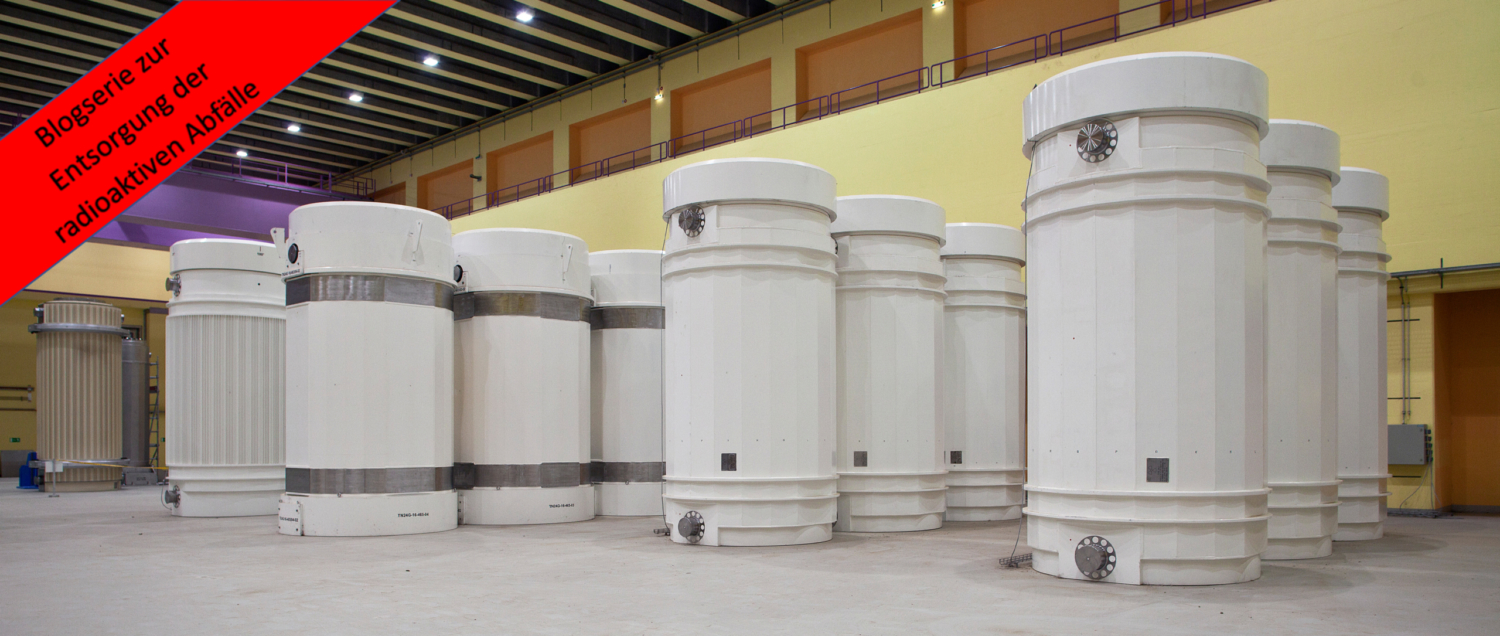 Zwischenlager Würenlingen; (KEYSTONE/Gaetan Bally)
The law stipulates that Switzerland's radioactive waste must be disposed of in deep geological repositories. But is a single combined repository - as proposed by Nagra in September 2022 - sufficient for the radioactive waste that has already been produced in Switzerland and will be produced in the coming years? How large is the amount of waste that needs to be stored? Answers to these questions are provided in the third part of the energeiaplus series on the handling of radioactive waste in Switzerland.
Disposal paths
Contrary to what one might intuitively assume, not all of Switzerland's radioactive waste will end up in a deep geological repository. In addition to deep geological disposal, the law also provides for decay storage, controlled release into the environment or conventional incineration or landfilling for very short-lived or low-level waste (see Figure 1). Until the 1980s, around 5000 tons of low-level waste from Switzerland were dumped in the Atlantic (see Article 1 of this blog series).
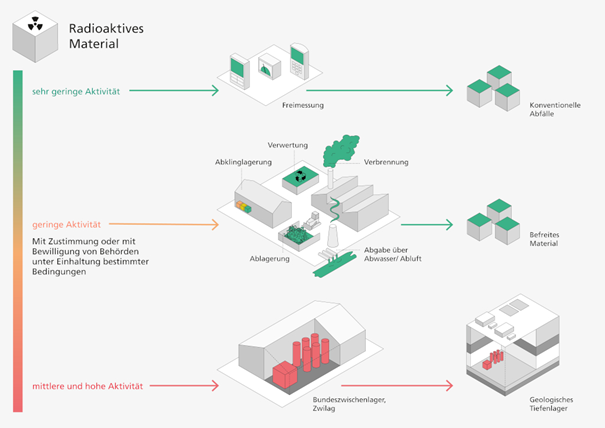
Figure 1: Disposal paths of radioactive waste in Switzerland. Source: FOPH
Quantity and development over time
The total volume of waste for deep geological disposal includes all waste that is already in interim storage today. The quantity of this waste is precisely known. In addition, there is the waste that will be produced in the future. This quantity depends on various factors and assumptions that may still change: the effective lifetime of nuclear power plants, technical developments in the processes that generate the waste, or potential applications in the fields of medicine, industry and research. The quantities of existing and future waste together form the "Model Inventory of Radioactive Waste (MIRAM)", which is determined and regularly updated by Nagra. The MIRAM in its current form forms a planning basis for the planning of deep geological repositories.
Figure 2 shows the observed and expected development of the volume of radioactive waste over time. The decisive factor in determining the required size of the repository is the volume of waste in the form in which it must one day be disposed of in the repository in order to protect people and the environment. For this purpose, the waste must be pretreated accordingly and packaged in disposal containers. The model assumes a service life of 60 years for each of the Beznau, Leibstadt and Gösgen nuclear power plants and 47 years of actual operation for the Mühleberg nuclear power plant, which is already in the process of being decommissioned. A collection period until 2064 is assumed for waste from medicine, industry and research. According to this model, a total of 82,534m3 of packaged radioactive waste will be produced for disposal in deep geological repositories.
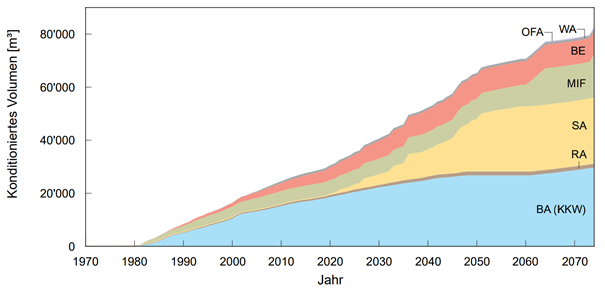
Figure 2: Timeframe for the generation of radioactive waste packaged in disposal containers in Switzerland inm3 for the existing nuclear power plants (NPPs) for 60 years of operation and 47 years for the Mühleberg nuclear power plant. A collection period until the end of 2064 is assumed for waste from the medical, industrial and research sectors (MIR). BA: Operational waste, RA: Reactor waste, SA: Decommissioning waste, BE: Fuel assemblies, WA: Waste from reprocessing, OFA: Waste from the surface facilities of the deep geological repositories.
From: Waste management program 2021 of the waste producers; NTB 21-01, Nagra, 2021.
Most of the waste (80% of the total packaged volume) to be disposed of in the deep geological repository comes from nuclear power plants. The spent fuel elements account for around 11%, the waste from the reprocessing of spent fuel elements around 1%, the waste from the reactors around 2%, around 36% comes from the operation and around 30% from the decommissioning of the nuclear power plants. Added to this is waste from medicine, industry and research (19%) and waste from the future operation of the deep geological repositories themselves (1%). The graph also shows that only just under half of the expected amount of waste has been produced to date, mainly because the Beznau, Gösgen and Leibstadt nuclear power plants are still in operation. In particular, the large volume of decommissioning waste from the nuclear power plants will only be generated in the future. By way of comparison, the predicted volume of 82,534m3 is roughly equivalent to the contents of 33 Olympic-sized 50m swimming pools. Or: Spread over around 2500 sea freight containers, this volume would fill around one tenth of the loading capacity of the largest ocean-going container ship currently in operation.
Comparison of radioactive and conventional waste
According to waste statistics from the Federal Office for the Environment FOEN, around 90 million tons of (non-radioactive) waste are produced in Switzerland every year. Over 60% of this is excavated and excavation material, most of which can be recycled. The annual volume of municipal waste is around 6 million tons. Around 1.4 million tonnes of hazardous waste, i.e. waste whose environmentally sound disposal requires special technical and organizational measures due to its composition, chemical-physical or biological properties, was disposed of in Switzerland in 2021. Of this, around 150,000 tons were deposited in surface or underground landfills. This quantity is comparable in size to the mass of radioactive waste that will one day be sent to deep geological disposal. According to the current MIRAM, the mass of radioactive waste (unpackaged) is around 120,000 tons.
It is also interesting to see how the radioactivity is distributed within this waste. High-level waste accounts for 11% of the total volume of packaged waste, while the remaining 89% is made up of low- and intermediate-level waste. According to the current MIRAM(Nagra NTB 22-05, 2023), the total activity of all waste in the reference year 2075, when emplacement is expected to be completed, will correspond to 1.9-1019 Becquerel, i.e. 19 trillion nuclear decays occur per second in the entire material. More than 99% of this radioactivity is attributable to the high-level waste alone. In other words, a large proportion of the radiation comes from a relatively small amount of material. For this reason, different realization concepts for deep geological disposal are implemented for the waste categories of high-level waste on the one hand and low- and intermediate-level waste on the other, which meet the requirements for the properties of these types of waste. Even if Switzerland approves the proposed combined repository one day, two deep geological repositories will technically be realized at the same site, both of which will have the same access point on the surface and a common supply infrastructure.
Storage capacity
Following its site proposal in September 2022, Nagra is currently preparing its application for a general license for a combined repository in Nördlich Lägern. When granting the general license for a deep geological repository, the Federal Council will set a maximum storage capacity. Applicants for a deep geological repository must therefore provide information on the maximum required storage capacity in their application. These will be reviewed by the Swiss Federal Nuclear Safety Inspectorate ENSI. The maximum storage capacity to be specified with the general license should be calculated in such a way that sufficient planning reserves are taken into account for deviations from the waste volumes expected today. At the same time, sufficient underground space must be available at the designated site. The safety of construction and operation, as well as the long-term safety of the repository, must be demonstrated.
Philippe Schaub, Radioactive Waste Disposal Specialist, Swiss Federal Office of Energy
Image: Würenlingen interim storage facility; (KEYSTONE/Gaetan Bally)
In Switzerland prescribedthat waste be safely disposed of in deep geological repositories in the long term. The site selection process for this has been underway since 2008 in accordance with a sectoral plan. It is planned that the site selection process will be completed by 2031.
The Swiss Federal Office of Energy is leading this process under the title "Sectoral plan for a deep geological repository". It involves broad participation by the canton, municipalities and population.
The following have been published to date:
Dealing with radioactive waste in Switzerland - Part 1: 1900 - 1980 | SFOE magazine energeiaplus | Energy magazine of the Swiss Federal Office of Energy
Dealing with radioactive waste in Switzerland - Part 2: up to 2008 | SFOE magazine energeiaplus | Energy magazine of the Swiss Federal Office of Energy
 2 Vote(s), Durchschnitt: 5,00
 Loading...



Neuste Kommentare