Fresh air generated in aircraft cabins without any emissions
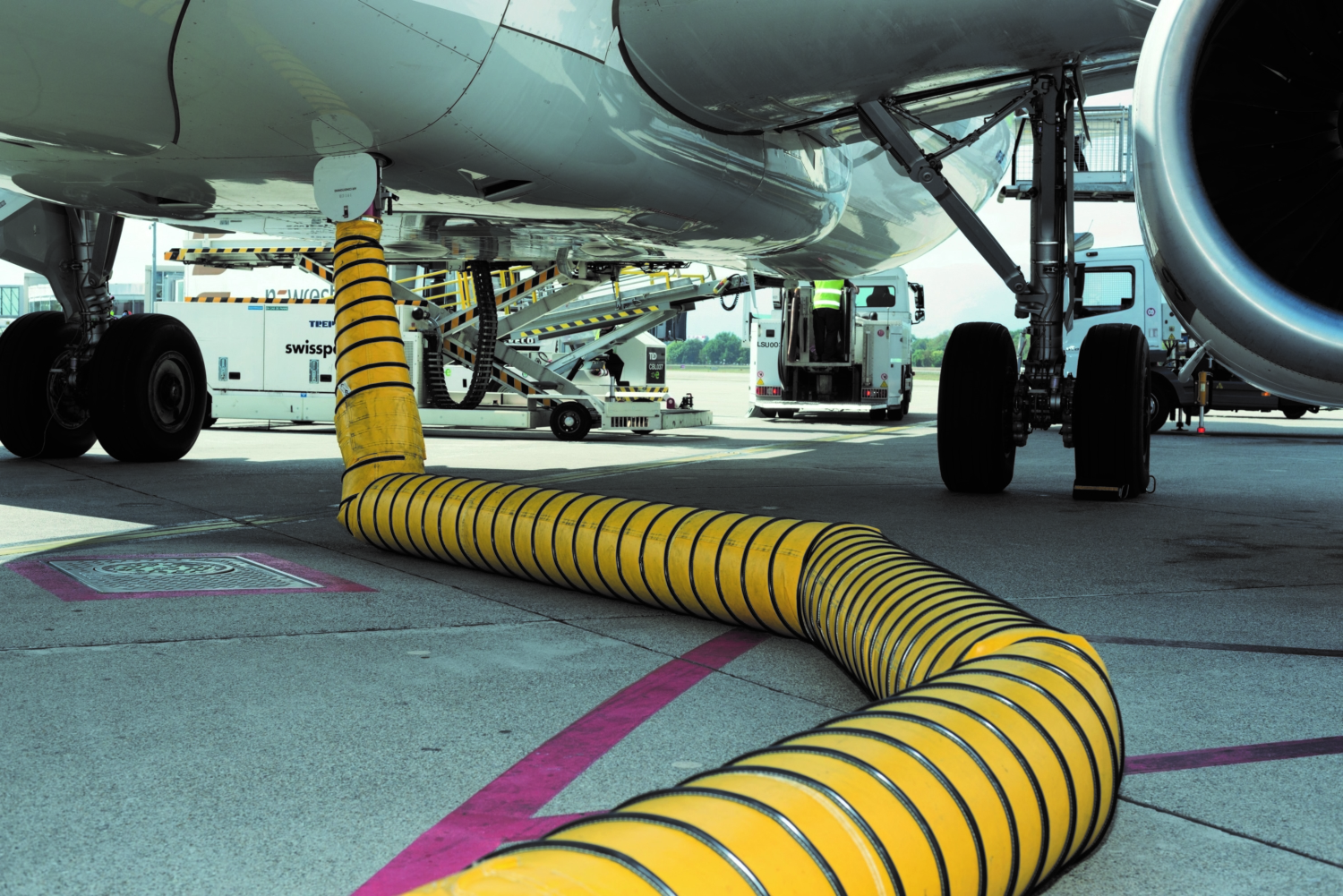
Ecological air-conditioning of aircraft cabins can be achieved at Geneva airport with the help of a new heat pump system.
It was just 117 years ago that man first successfully overcame gravity and safely flew through the air in a humming motorized vehicle. The airplane that was once a sensation is now a common means of transportation. But a human-friendly climate in the passenger cabin is essential for a stay at an altitude of 11,000 metres. Special air-conditioning systems, i.e. ECS(Environmental Control Systems), ensure this. The high-performance units regulate temperature, air pressure and oxygen content. They are operated by the aircraft's engines as long as the aircraft is in flight. But even on the ground, the cabin atmosphere is tempered during thestopover. Geneva Airport has optimised this process from an energy point of view in recent years and has thus reduced both noise andCO2 emissions.
Air conditioning in the cabin during the stopover
Passenger cabins were also air-conditioned in the past on the Geneva airport ramp using the aircraft's internal ECS system. In contrast to the operation in the air, however, an auxiliary power unit was used as the power source for the air-conditioning system. This also runs on kerosene and is extremely noisy. To be more efficient in this respect, Geneva Airport has installed a central heating and cooling system to supply the cabins with fresh air during the stopover.
Refrigeration machines are used for refrigeration in the summer. The refrigeration circuit required for this purpose must be constantly maintained at a temperature of - 16 °C, so that the cabins can be quickly connected and cooled. The system therefore operates continuously, even if it is not required at all times. The same applies to oil heating, which is used in winter. Compared to the aircraft's own DHW system, this type of ventilation mainly reduces noise emissions. From an energy point of view, oil heaters and refrigeration units are already a thing of the past today. This is why Geneva Airport is taking another step forward this year and replacing the existing system with a solution that optimises energy efficiency.
Heat extracted from the air
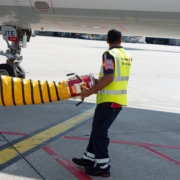
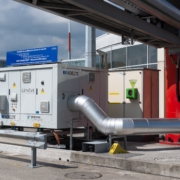
As is often the case, heat pumps are the successor to oil heating and refrigeration machines. After carefully evaluating various systems, the project team led by Fabio Bernardo opted for air-to-air heat pumps. This variant proved to be the most efficient for the temperate climate in Geneva. In contrast to the previous centralised system, 24 individual heat pumps are now installed at the foot of the passenger bridges. In any case, the boarding stairs are close to the machines during stopovers and are therefore ideally suited as installation locations. Flexible hoses connect the heat pumps to the opening in the aircraft fuselage.
In 2017, a first heat pump of this kind was introduced on an experimental basis. Project manager Fabio Bernardo explains: "This prototype enabled us to carry out all the necessary tests, so we decided on this heat pump technology". Installation of the heat pumps started in 2019 and will be completed by the end of this summer 2020.
Innovation in all directions
Not only are fewer noise emissions now produced on the apron due to the new heat pump-based ventilation system, butCO2 emissions are also considerably reduced. Heat pumps cause virtually no emissions, as they extract heat or cold from the ambient air. They run on electricity from renewable energy sources. Project manager Fabio Bernardo adds: "What's more, we can switch the pumps on and off relatively quickly. In contrast to the previous system, they only work in this way if they are actually used. Even the quality of the air in the cabin is better than with the old system. This saves us almost 30,000 tonnes ofCO2 per year, which is equivalent to about 4,560 flights from Geneva to London. "Bernardo and his team plan to install the remaining heat pumps by November of this year.
Laura Scheiderer, Communication Energy Exemplarity, Polastern
Pictures: Geneva Airport
 Noch keine Bewertungen
 Loading...





Dein Kommentar
An Diskussion beteiligen?Hinterlassen Sie uns Ihren Kommentar!